18 / day
Status changes vs target 12
Average per active day, with a team-high of 22, on a 1,400+ work order portfolio.
Engineered the Python platform that runs work orders for 900+ D.C. public facilities, with approval and backup on every change.
18 / day
Status changes vs target 12
Average per active day, with a team-high of 22, on a 1,400+ work order portfolio.
~870
Duplicate records found
Found by auditing Salesforce data with Python, the REST API and CLI, closing a major reporting gap.
0
Writes without approval
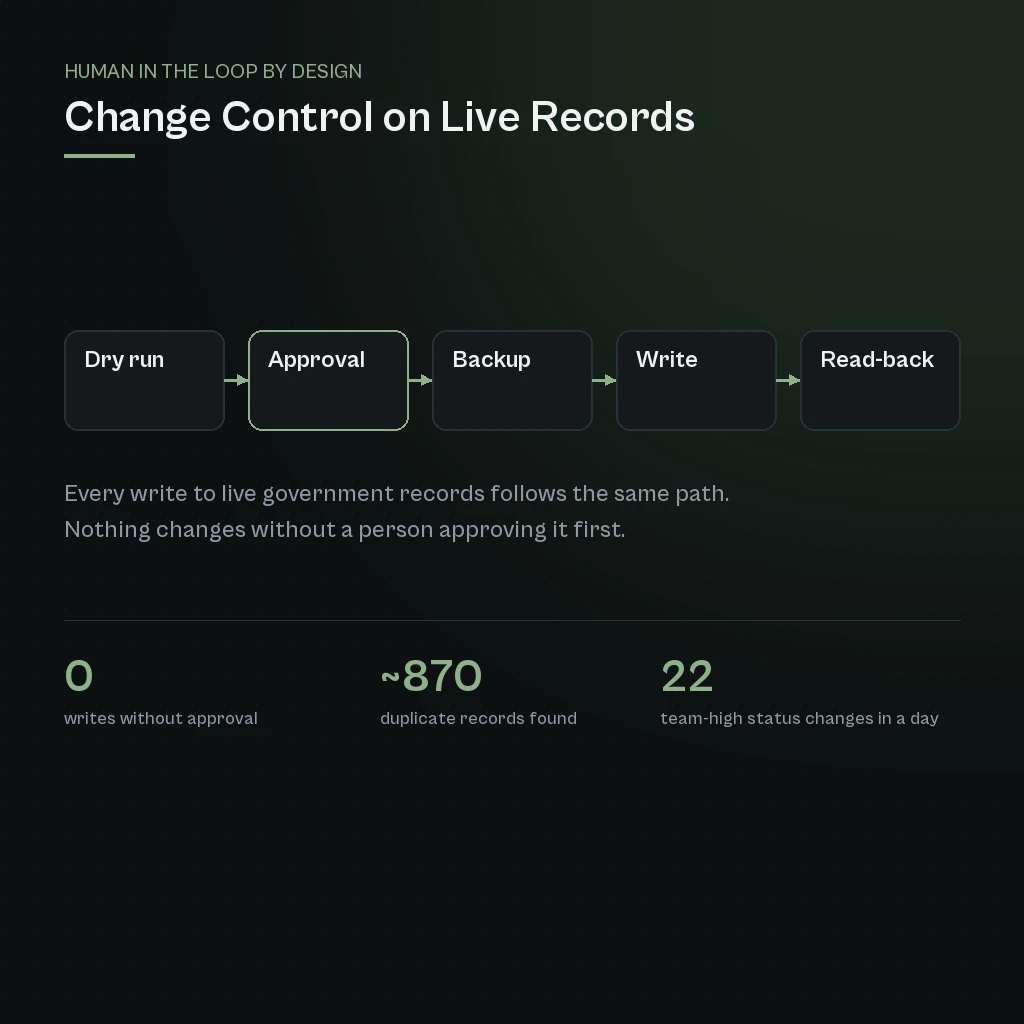
Every change runs a dry run, waits for approval, takes a backup, writes, then reads the record back.
Operating Context
A manual, high-volume government operation became an engineered system: a 5,300-line Python platform that moves 1,000 to 3,000 work orders a month from intake to an audit-ready close, with a person approving every change to live records.
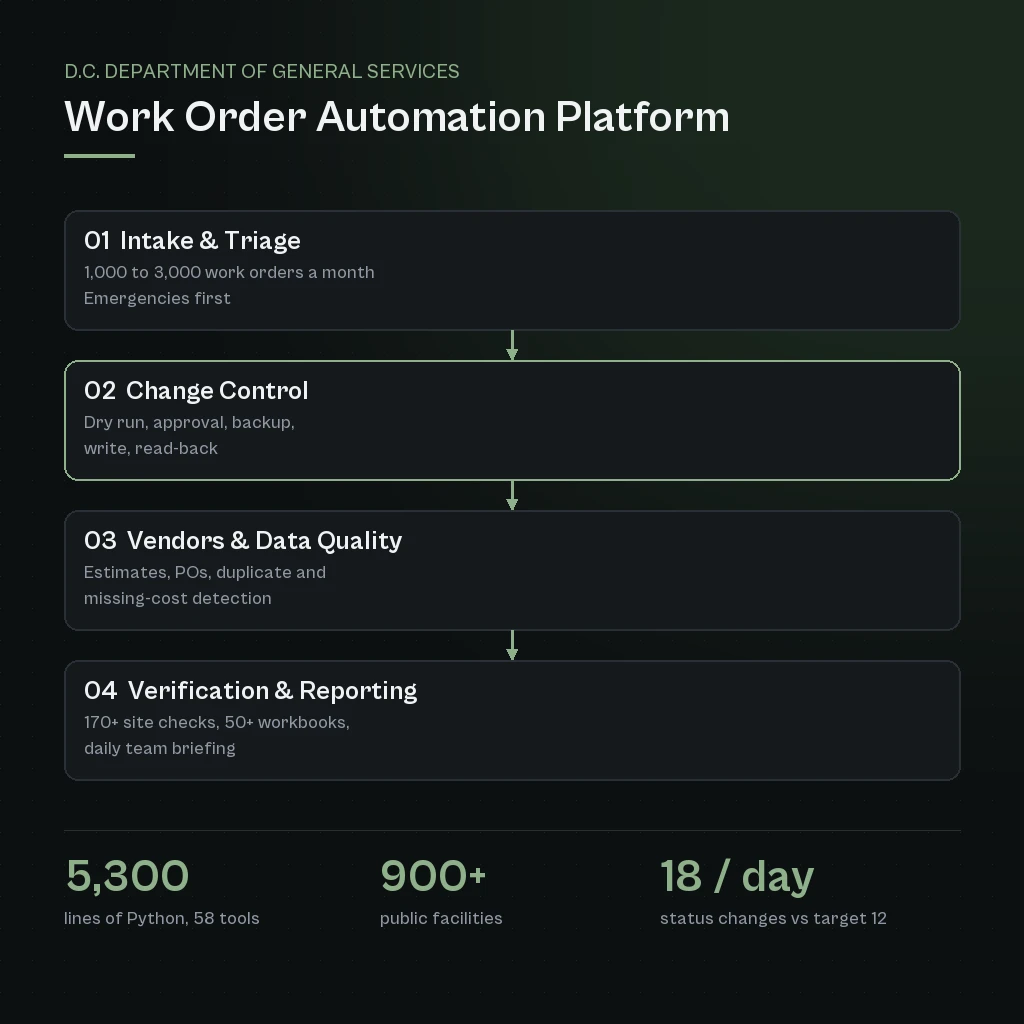
D.C.'s Department of General Services runs repair work orders for 900+ public facilities (schools, parks, fire, police) through Salesforce. A 3-person team handled 1,000 to 3,000 work orders a month by hand: intake, assignment, vendor emails, costs, field verification and reporting.
Engineered a 5,300-line Python platform (58 tools, 8 modules) on the Salesforce REST API that runs the work order from intake to an audit-ready close. Every write to live records goes through a dry run, approval, backup and read-back, and AI-drafted vendor and stakeholder messages wait for human approval before anything goes out.
Work order handling went from hours to minutes. 18 status changes per active day against a target of 12 (team-high 22), about 870 duplicate records found and cleaned, and 0 writes to live government records without approval.
Architecture
Requests become tracked tickets, emergencies first: schools, parks, fire and police.
Dry run, approval, backup, write and read-back on every update to a live record.
Vendor emails, estimates and purchase-order reconciliation, plus duplicate and missing-cost detection.
170+ field inspector site checks, 50+ reporting workbooks and a daily team briefing.
Delivery Conditions
Judgment
Automation drafts and prepares; a person approves. The team gets speed without risking the integrity of government records.
58 focused tools across 8 modules, each shipped after a requirements review with the team lead and a built-in self-test.
AI drafts vendor, building manager and stakeholder messages; nothing goes out until someone approves it.
Similar Operational Problem?